
The Energy Board After Beijing
Charif Souki on what moved, what didn’t, and what the next 90 days will decide


June 4, 2026
The Geometry Room | Checking in with Charif
Checking in with Charif is how The Geometry Room stays current on the energy board. Charif Souki lit the fuse on the American LNG boom. We check in with him as the board moves. What changed. What didn’t. What everyone’s missing.
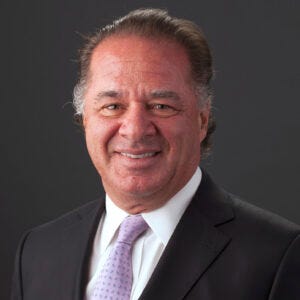
In our first Geometry Room interview on April 22, Souki laid out the new energy architecture: “Forget OPEC. It’s America plus GCC.” Six days later, the UAE left OPEC. Two weeks later, Souki was on Bloomberg saying the same thing to a global audience. Today we sit down again to cover what’s changed since then: the Beijing summit, the data center reckoning, Canada’s pivot, Russia’s Arctic corridor, and why the Hormuz math makes a deal inevitable.
ACE: The Beijing summit happened. Trump met Xi. What did you see?
Charif: It’s mostly a matter of atmospherics. They were both very nice to each other. Nothing serious was announced. But the question is what happened in the background.
For me, the more telling summit was the Putin-Xi meeting a few days later. Putin was trying to sell his gas, and Xi didn’t want anything to do with it. That was surprising. I thought I would see China diversifying its supply sources.
Xi has more important things on his mind. He’s under pressure. The Chinese economy is not doing well. He’s not yet stressed about energy prices, but that’s not something he’s looking forward to living through much longer.
What I find interesting is the bigger shift. It’s becoming clear that invading somebody else’s country is not a good idea. A blockade is much more efficient. So there’s a combination of military and economic power that's proving a better tool than simply invading people. The world is drawing lessons from this.
ACE: After three months of the Hormuz disruption, where do we stand? You said on Bloomberg, “There’s no energy crisis”.
Charif: I confirm what I told you in April. We still don’t have an energy crisis. The prices of coal and electricity have not changed dramatically globally. It’s just the price of oil.
The fact that we’ve been able to absorb a massive disruption, 20% of all flows, without a major impact is very telling by itself. Roughly so far, maybe 4 million barrels a day of easy demand destruction: China not building storage anymore, and some switching from oil to coal, gas, or renewables. Nothing that disrupts people.
And look at the supply response. The delta between last year and this year in America is 2 million barrels a day. The market handled this disruption much more easily than anyone expected.
In the United States, demand for gasoline has not decreased. Demand for jet fuel has not decreased. Americans are still driving and flying as much as they were, despite the price increase. The impact on the American economy is insignificant.
We really are a Petro State. The Americas have doubled their oil production in the last 25 years, from 20 million barrels a day to 40 million barrels a day. That’s about 40% of global oil production from Alaska to Argentina. At the same time, oil’s share of total energy consumption has decreased from 40% to 30%. The combination of those two factors means we are insulated.

ACE: China reportedly agreed to buy $52 billion in American energy after Beijing. Is that real?
Charif: That’s the kind of nonsensical statement that people make. There’s a huge difference between the US and Canada on one side and everybody else on the other. We’re market-driven economies.
There is no central organization that is going to tell Chevron, Exxon, ConocoPhillips, or Occidental Petroleum that you will sell this particular product to somebody. The market takes care of that. We’re market-directed.
To the extent that China wants to buy American oil, it’s free to do so. All they have to do is pay more than the next guy. We don’t have a politician who’s capable of saying I will make sure you receive more oil.
China can direct its companies because it’s a directed economy. But they’re going to buy the cheapest oil they can get.
ACE: You said “Forget OPEC” on April 22. The UAE left on May 1. ADNOC’s XRG arm is now evaluating 29 US gas acquisitions. What’s the play?
Charif: The UAE has a lot of money to invest, and they’re always looking for the best place to invest it. The resource in the United States is absolutely huge. I don’t think there’s a limitation on how much more we can grow our production.
The latest statement from XRG that they want to be fully integrated in the United States is entirely coherent. It’s a very smart strategy. Of course, I say this because I’ve been advocating this for a decade now.
When you become a commodity producer, the most important thing you can do is make sure you’re in the top quartile in terms of your cost structure. There aren’t many places that give you that luxury. Abu Dhabi’s investment vehicles concluded that the US resource is huge, which is correct. That it is relatively cheap, which is also correct. And that there is an infrastructure issue getting it to the water, which is also correct.
Therefore, the model in the US needs to change to a fully integrated model that puts American molecules on the water at the lowest possible price. LNG is now one of the top five traded commodities in the world. It needs to follow the rules of commodities.
And this isn’t just about the existing basins. We have three world-class basins in the United States: Appalachia, Haynesville, and the Permian. Those did not exist 15 years ago. The Permian Basin has been developed to only 10% of its ultimate recovery potential. We have a long way to go.
And the thing I find fascinating is the convergence between large energy companies and large tech companies. Microsoft, Palantir, and Google are collaborating with the Energy Giants to use artificial intelligence to streamline drilling methods. Technology is moving extremely quickly.
ACE: Is Abu Dhabi investing for geopolitical reasons or commercial reasons?
Charif: I don’t think it has to be either/or. Doing it for political reasons without commercial support would be very difficult. And doing it for commercial reasons without political support would be very difficult. You combine the two elements that are necessary.
In the United States, we tend to be more open to foreign investments. We have rules of law and people can make investments and be fairly safe that we’re not going to change our minds. It’s a good environment, and the resource has been proven.
ACE: Canada just signed an LNG deal with Germany. Ksi Lisims in British Columbia, 20 years. What’s your read on the Canadian pivot?
Charif: They have two world-class basins, the Montney and the Duvernay, that are barely touched at the moment. The geographic constraints were real: you have to go through mountain ranges to build pipelines, pristine locations, and First Nations issues. So it was very difficult to get projects approved.
The Ksi Lisims project is run by Davis Thames, a very good friend of mine who used to work with me for 10 years. He’s been very patient, working on this for almost a decade. He combined the First Nations with the project very smartly.
Those two basins will be basins of the future for Asia. It’s another reason why the Americas as a bloc are going to dominate the next few decades of the energy world. The center of gravity will change. Canada produces 6 million barrels of oil. It’s not insignificant. And they have the potential of being a very powerful player in natural gas as well.
ACE: Russia just sent the Christophe de Margerie through the Arctic to Southeast Asia, bypassing Hormuz, Suez, and Bab al-Mandab. Threat or blip?
Charif: It won’t make a big difference. It’s nice if you have a project in the Arctic and the route opens up. It’s a shorter route. Makes sense for a Siberian project. Novatek was able to build some Arctic facilities for a very attractive price.
But for the LNG trade in general, it won’t move the needle. The question going forward is whether you can actually sustain it.

ACE: We pushed back on your “America plus GCC” framework last time. Is the GCC in troubled waters? Is it really just the Americas now?
Charif: People always have a chance to be stupid. There is a central change occurring, and either you want to be part of it or you’re going to be left behind.
If you told GCC countries 3 or 4 years ago that OPEC was not going to be relevant anymore, they would have laughed. Today they’re looking at what’s happening in the Americas and saying, maybe we shouldn’t fall behind.
Just numbers: the GCC is half the size of the Americas. If you’re going to take my Americas plus GCC framework, you have to assume the GCCs work with each other and the US works with Canada and the rest of the Americas. If you manage a pathway for all of this, you’re talking about 60% of the world’s hydrocarbons.
For the Middle East, you have a bloc of about half a billion people if you count Egypt and Turkey. People, wealth, education systems. Why not have a cohesive bloc? Look at the European Union, they still don’t know how to get their stuff together. But are we more challenged? No, because we have more resources and we have population.
We have to do in a hundred years what Europe did over a thousand. If you look at the first 50 years, the track record is not bad. The level of sophistication, the level of education, the acceptance of women in society, the increased tolerance, all of that has improved dramatically.
So I’m actually very optimistic about this region. And believe it or not, that optimism extends to Iran.
ACE: Iran’s regime has changed. The IRGC has taken over from the religious establishment. What’s the inflection point?
Charif: They’re far-right technocrats. The fabric of power has shifted. The regime is no longer dogmatic, no longer religious in its decision-making. It is basically far-right, autocratic, and transactional. As long as they can make money for themselves and their people, the ideology takes a back seat.
And you can see it on the ground. The images coming out of Iran now- women in the streets wearing the chador or not wearing the chador- are moving in the right direction from a social standpoint.
The decision point now is: do they want to model themselves and ally themselves with the Chinese model or the Western model? That’s their inflection right now. And if Trump seizes that particular point, he may transform Iran into this type of regime.
At some point, they’re going to say: we need to provide a lifestyle to our 90 million people. And for that, they need money. Controlling the Strait of Hormuz gets them $10 to $14 billion a year. Being allowed to sell another million barrels of oil on the open market gets them $60 to $80 billion a year. The math is clear.
So you will find, at some point, a reconstruction fund being announced. The new technocrats in charge will take it. And I have a decent amount of optimism about eventually including Iran in the broader Middle East picture. The region would benefit enormously from 90 million educated, resourceful people rejoining the community of nations.

ACE: Energy-to-intelligence. The data center buildout. Everyone’s talking about 100 gigawatts. What’s realistic?
Charif: Everything you’re hearing about the construction of AI data centers is pie in the sky. We don’t have the bandwidth to build what they want us to build. We don’t have the labor, the scale, the ability.
Right now, the United States has about 60 gigawatts of AI and data center capacity. They want to talk about putting 100 more gigawatts in the market. It’s just not going to happen. Every gigawatt costs $20 to $25 billion to build. You have to develop your power source for it.
There are maybe 4 or 5 construction companies capable of taking a piece of this. My assessment: we’re going to build about 30 gigawatts over the next 5 years, from the 100 that have been announced. And maybe another 10 from the existing grid.
The grid won't be able to deliver the electricity needed. So all hyperscale data center companies will have to put their power generation on campus. And if they do that, power generation accounts for about 7-8% of the total cost. Nobody’s going to build power generation alone; they need the whole project.
For the tech companies, it’s existential. They can’t afford to lose their franchise. But they don’t know if it’s going to pay off. Google is raising $80 billion. CapEx has gone from zero to 110-120% of free cash flow. The correlation between CapEx and revenue is positive, but you have only two or three years of data.
So we’re going to have a readjustment downwards. The 30 to 40 gigawatts over 5 years will require about 6 billion cubic feet of gas. The answer to the domestic demand question: it won’t make a difference. We have enough reserves to meet demand for 100 years.
And the LNG story is bigger. Since our last conversation, I’m aware of at least another 30 to 40 million tons of liquefaction capacity coming to market after the current construction cycle. That’s far more significant for gas demand than anything to do with data centers.

ACE: Last question. What should we be watching over the next 90 days?
Charif: My best guess is we’re going to find that there is an agreement for the Strait of Hormuz. The Iranians need money, and the math favors a deal over a blockade. The new leadership is transactional. They’ll take it.
And the whole Middle East, 500 million people, needs all the gas it has. Probably needs to import more. So the energy story isn’t just about exports. It’s about whether this region can build a cohesive bloc with the resources it has and the population to consume them.
P.S. Hours after our conversation, Souki sent us a note: China’s oil import numbers for May are coming in. They were down significantly, which would indicate either that they are drawing down inventories or that they are suffering from greater economic weakness. Either way, not sustainable. Pressure for a solution will increase.
Checking in with Charif is how The Geometry Room stays current on the energy board. Souki’s views are his own, drawn from decades at the frontier of American energy.
The Geometry Room is published by The ACE Dispatch, an ACE*D Global publication. If you know an expert who belongs in this room, tell us: ace@aced.global
Read the full first interview: Charif Souki on American LNG and the New Energy Order
Read the companion dataset: “Forget OPEC” — The Data Behind the New Energy Order
We see geometry where others see chaos.
© 2026 The ACE Dispatch. All rights reserved.